
Choosing software for a black car, chauffeur or limousine company is not as simple as comparing one monthly price.
Two platforms may both advertise online booking and dispatch, yet the actual cost can be structured very differently.
One company may charge a monthly subscription. Another may charge by trip volume. A third may combine a subscription with setup fees, per-trip charges and optional modules. And some platforms use a percentage of the transportation revenue processed through the system instead of a traditional software subscription.
For operators, the important question is not:
“Which system has the lowest advertised price?”
The better question is:
“What will this system actually cost my company at our volume, and what operational work does it replace?”
This guide breaks down the most common pricing models used by black car and chauffeur software platforms in 2026 and explains how to evaluate them.
Why Black Car Software Pricing Is Difficult to Compare
Transportation software can cover many different functions. Depending on the platform, one subscription may include:
- Online reservations
- Customer quotes
- Dispatch
- Driver management
- Vehicle management
- Customer communications
- GPS tracking
- Payment processing
- Reporting
- Affiliate management
- Customer apps
- Review follow-up
Another platform may provide only some of those features and charge separately for the rest.
That is why comparing software based only on the monthly subscription can be misleading. A $99 plan may be a better value than a $49 plan if it eliminates several other tools.
At the same time, a percentage-based system can become more expensive than a flat monthly subscription as revenue grows.
The correct answer depends on how the transportation company operates.
The Four Common Pricing Models
Most transportation software falls into one of four general structures.
Monthly Subscription
A fixed monthly fee for platform access. Easiest to budget. Cost does not increase with revenue. Attractive for established operators with predictable volume.
Subscription + Usage
A base monthly subscription plus additional charges based on trips, messages, modules or other usage. The monthly price is only the starting point.
Tiered Plans
Basic, Plus, Premium or Enterprise tiers. Higher tiers add features like passenger apps, advanced reporting, affiliate connectivity or additional brands.
Percentage-Based
The platform keeps a percentage of eligible revenue. Attractive for inconsistent volume. The tradeoff: as revenue grows, the platform cost grows with it.
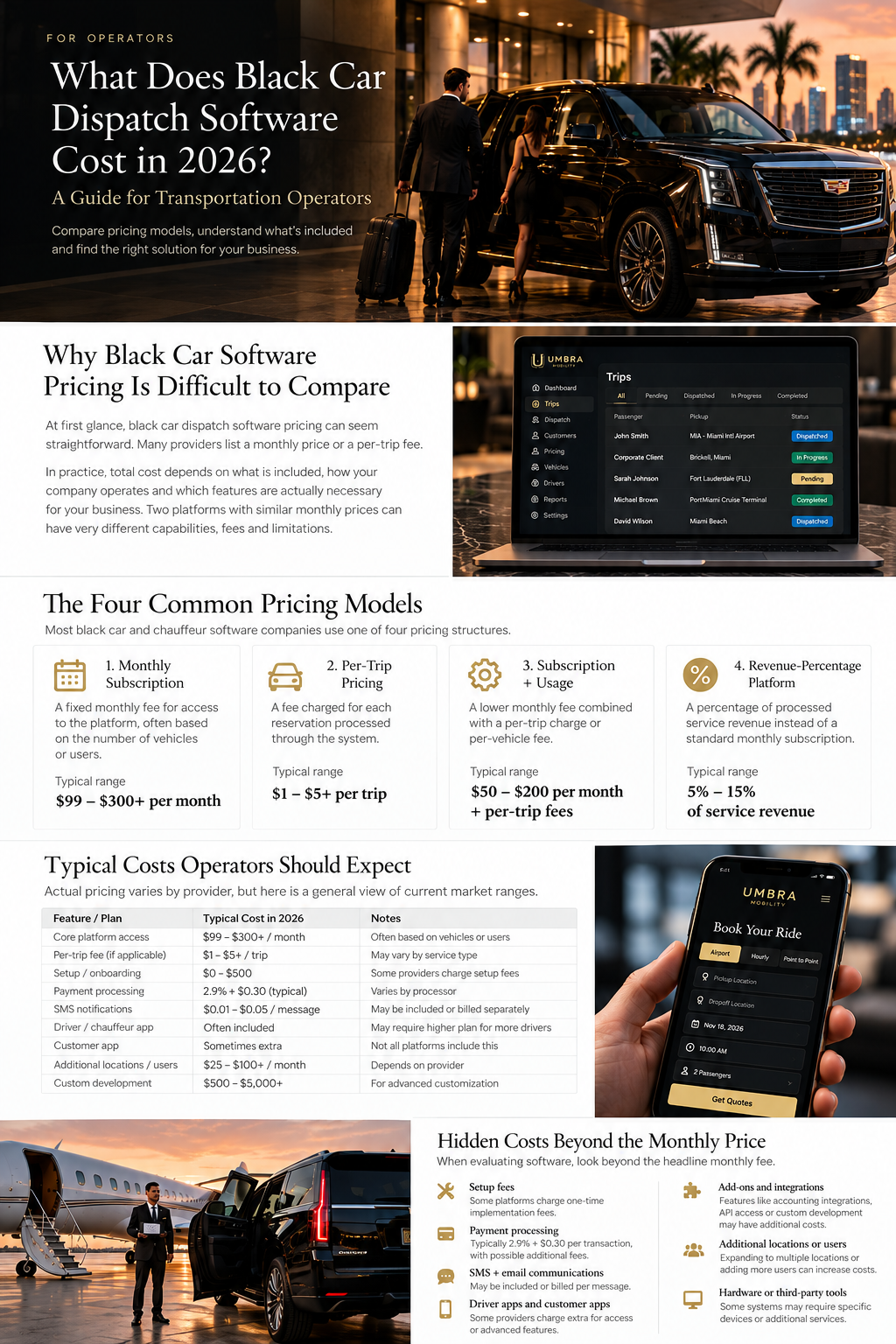
The four common pricing structures for black car and chauffeur dispatch software
What Are Transportation Software Companies Charging in 2026?
Published pricing across the industry shows how different these structures can be.
As of October 2026, Booking Tool lists its limousine platform at $99 per month for up to 200 bookings, $179 for up to 400 bookings and $239 for up to 600 bookings, with a one-time $299 setup fee. It also lists additional bookings at $0.50 each and an optional branded app at $49 per month.
RideBits currently lists a Solo plan at $99 per month and a Fleet plan at $249 per month. Both include 100 trips, with additional trips charged at $1 each. RideBits states that customer payments flow through the operator’s own Stripe account and that the company does not take a percentage of fares.
Limo Anywhere uses a combination of monthly plans, trip charges and setup fees. Its published pricing currently starts at $99 per month for Core, $249 for Plus and $549 for Black. Core lists a $299 upfront fee, Plus $599 and Black $899, with per-trip pricing and additional paid modules depending on the plan.
Those are very different economic models even though the systems overlap in reservations, dispatch and transportation management.
| Platform | Entry Pricing | Additional Cost Structure |
|---|---|---|
| Booking Tool | From $99/mo | $299 setup; volume tiers; additional bookings; optional branded app |
| RideBits | $99 Solo / $249 Fleet | 100 trips included, then $1/trip |
| Limo Anywhere | From $99 / $249 / $549 | Upfront licensing/setup, per-trip charges and optional modules |
| Powered by Umbra | 8% of applicable revenue | 3.5% processing recovery on approved pass-through charges; no separate monthly software subscription |
Published software prices and features can change. Operators should always verify current pricing directly with each provider before making a purchasing decision.
The Monthly Subscription Is Not the Whole Cost
When evaluating a platform, operators should look beyond the number shown at the top of the pricing page. Several other costs can materially change the economics.
Setup and Onboarding
Some software platforms charge an upfront implementation or licensing fee. That may cover configuration, onboarding or training. For a growing company, a setup fee may be perfectly reasonable. It simply needs to be included when calculating the true first-year cost.
Per-Trip Charges
Trip-volume pricing is common. An operator may pay a monthly subscription and then an additional amount for every reservation processed. At low volume, that fee may be insignificant. At hundreds or thousands of reservations per month, it becomes important.
Additional Modules
Features that appear to be part of the overall platform may require separate subscriptions. Examples can include:
- Passenger applications
- Additional company brands
- Messaging tools
- Lead management
- Affiliate connectivity
- Shuttle functionality
Payment Processing
Software cost and payment-processing cost are not always the same thing. A platform may integrate with Stripe, Square or another processor while the operator still pays normal card-processing expenses.
Operators should determine: Does the advertised software price include payment processing, or is payment processing a separate expense?
SMS and Customer Communications
Automated customer messages can become another variable expense. Some platforms include messaging. Others charge based on usage or require an external provider.
Branded Customer Applications
A customer-facing branded app can be included, optional or available only on a higher plan. If the company’s strategy actually requires an app, that cost belongs in the comparison. If customers are happy using a mobile-friendly booking page, paying for an app may not be necessary.
What Does a $99 to $300 Monthly Software Plan Actually Buy?
For many small transportation businesses, the $99–$300 range is where serious transportation software begins to become available. Within that range, operators can find platforms offering combinations of:
- Reservation management
- Online booking
- Dispatch
- Driver access
- GPS tracking
- Customer notifications
- Pricing tools
- Payment integration
- Reporting
The important question is not whether a platform has fifty features. It is whether the operator will actually use them.
When Flat Monthly Pricing Makes Sense
A traditional subscription can be attractive when the operator has consistent booking volume.
Imagine two companies.
High-volume operators can benefit significantly from fixed or mostly fixed pricing. That is one reason percentage-based platforms should not automatically be described as cheaper. They solve a different problem.
When Percentage-Based Pricing Can Make Sense
A percentage-based model changes the risk. Instead of paying for software every month regardless of activity, the operator pays more when the system processes more revenue.
For a smaller transportation company, that may reduce the commitment required to launch online booking. If there are no affiliate-generated bookings during a slow period, there is no large fixed software bill associated with those bookings.
That can make the structure attractive to:
- Owner-operators
- New transportation companies
- Seasonal operators
- Companies testing online booking
- Businesses with inconsistent direct booking volume
- Operators that want booking infrastructure without purchasing multiple software tools
The tradeoff is that successful high-volume operators should periodically compare the percentage cost against flat-rate alternatives.
How Powered by Umbra Is Priced
Powered by Umbra uses a different structure from a traditional monthly software subscription.
Under the current standard partner structure, affiliate-generated transportation and approved service revenue is subject to an 8% Powered by Umbra platform fee.
Approved third-party or pass-through items—such as designated airport fees, tolls or parking—are not subject to the full 8% platform fee. Those designated charges use a 3.5% processing-recovery deduction instead.
The current standard structure does not require a separate monthly software subscription. Individual affiliate terms may vary by written agreement.
The goal is to connect the platform cost directly to reservations actually being processed through the affiliate’s own Powered by Umbra booking channel.

Affiliates maintain their own company identity and customer-facing booking experience
What Does 8% Look Like in Real Dollars?
Consider affiliate-generated transportation revenue before any approved pass-through charges.
That demonstrates both the benefit and the tradeoff of percentage pricing. At low or inconsistent volume, there is no large fixed software subscription. At high volume, a traditional fixed-price software platform may eventually cost less strictly as software.
But software price alone does not tell the entire story.
What Is Included Behind the Powered by Umbra Fee?
Powered by Umbra is designed as more than a standalone booking form. The current platform brings together:
- Affiliate-branded booking pages
- Self-service customer pricing
- Add-ons and fees
- Integrated Stripe payments
- Automatic booking assignment
- Dispatch workflow
- Chauffeur trip statuses
- Customer trip tracking
- Customer communications
- Review follow-up
- Payout management
- Booking links and QR codes
- Optional access to Umbra’s affiliate network for qualifying overflow reservations
The affiliate’s own customers see that operator’s services and pricing rather than a marketplace of competing transportation companies.
That distinction matters when comparing the 8% fee with a pure software subscription. The operator is not simply purchasing access to a dispatch screen. The platform is also participating in payment flow, booking infrastructure and the broader Umbra operating network.
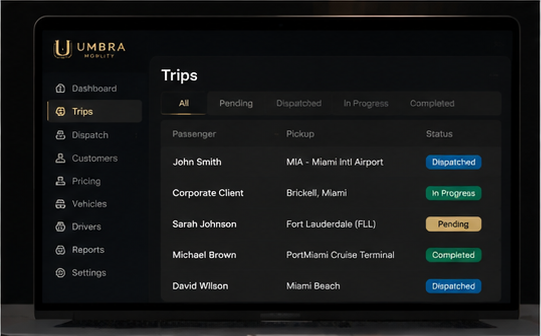
Trip management and dispatch workflow are included in the platform
Comparing a Subscription With a Percentage Platform
There is no universal winner. An operator should compare both models using actual business numbers.
For a traditional subscription, calculate:
Monthly subscription + trip charges + modules + payment-processing costs + messaging + annualized setup fees
For a percentage platform, calculate:
Eligible revenue × platform percentage + applicable processing-recovery costs
Then compare the functions each system replaces.
If one platform costs $150 less per month but requires separate systems for payments, messaging or customer booking, the lower advertised price may not actually produce the lower operating cost.
Questions Operators Should Ask Before Choosing Software
Before signing up for any transportation platform, an operator should understand several points clearly:
How is the software priced? Is it flat monthly, tiered, per trip, revenue-based or a combination?
Is there a setup fee? An inexpensive monthly subscription can have a meaningful upfront cost.
Are payment-processing fees separate? Do not assume integrated payments mean free payments.
Which features require upgrades? Online booking may be included while passenger apps, additional brands or advanced integrations cost extra.
Who controls the customer relationship? Does the customer remain within the operator’s branded experience, or enter a marketplace?
Can the operator control pricing? Airport, hourly, mileage, zone and add-on pricing can differ significantly from company to company.
Does a reservation automatically enter dispatch? If staff still have to manually recreate every web reservation, the system is only partially solving the problem.
Can the platform grow with the fleet? A solo operator and a 25-vehicle company have very different requirements.
Price Is Important. Workflow Is More Important.
A transportation company can lose more money through inefficient operations than it spends on software.
Consider the cost of:
- Missed after-hours bookings
- Incorrect manual pricing
- Re-entering reservations
- Forgotten follow-ups
- Dispatch mistakes
- Payment errors
- Poor customer communication
- Failed handoffs between office and chauffeur
A platform that removes some of those problems can create value even if it is not the cheapest software option.
That is why operators should evaluate software based on the complete workflow:
Customer inquiry → quote → reservation → payment → dispatch → chauffeur → trip completion → customer follow-up
The fewer disconnected systems involved, the easier the operation can become.
Which Pricing Model Fits Which Operator?
Solo Chauffeur
With only a few direct bookings each month, may prefer to avoid a recurring subscription until booking volume grows.
Small Fleet
With predictable monthly traffic, may prefer a traditional subscription because costs become easier to forecast.
Growing Operator
May choose an advanced platform with deeper reporting, accounting and staff-management capabilities.
Umbra Network Partner
May find Powered by Umbra attractive because direct customer bookings and affiliate operations exist within the same ecosystem.
The right choice depends on the business—not simply the software.
Should You Choose the Cheapest Platform?
Usually not.
Choose the platform that gives your transportation company the best relationship between:
Cost + capability + simplicity + customer ownership + growth potential
A cheaper system that employees avoid using is expensive. An expensive system filled with features the company never needs is also expensive.
The best platform is the one that supports the way the business actually operates.
Frequently Asked Questions
Published pricing varies considerably. Current industry examples include entry-level plans around $99 per month, higher fleet and advanced plans in the several-hundred-dollar range, and additional setup, per-trip or module fees depending on the provider.
Not necessarily. Booking software focuses on customer reservations and quotes, while dispatch software manages drivers, vehicles and active trips. Many transportation platforms now combine both.
Some do. Published examples include setup fees ranging from $299 to $899 depending on the platform and plan level.
Not always. Operators should check whether the platform includes payment-processing costs or simply integrates with a processor that charges separately.
Under the current standard partner structure, Powered by Umbra states that no separate monthly software subscription is required. Applicable affiliate-generated service revenue is subject to the platform’s percentage-based structure instead.
Yes. Approved operators can configure customer-facing rates, services and approved add-ons through their affiliate portal.
The current Powered by Umbra booking model is designed around customer isolation. Customers using an affiliate’s dedicated booking experience see that company’s services and pricing rather than competing operator booking pages.